How Pro Wrestling Storylines Are Actually Written


There is a moment in almost every pro wrestling fan's life when the curtain gets pulled back. Maybe you were a kid watching Monday Night Raw when someone explained that the outcomes are predetermined. Maybe you figured it out yourself when a move landed a little too cooperatively, or when a villain turned into a hero a little too cleanly. However it happened, the revelation that pro wrestling is scripted tends to land one of two ways: either you walk away entirely, or you lean in harder, suddenly interested in a completely different set of questions. Not “who's going to win?” but “how does any of this actually get made?”
Those second-category people — and there are millions of them — eventually discover that the behind-the-scenes machinery of professional wrestling is one of the more fascinating creative operations in entertainment. The writing rooms, the creative hierarchies, the politics, the last-minute rewrites, the difference between what gets planned months in advance and what gets improvised in a parking lot thirty minutes before showtime — it's a world that borrows from television writing, live theater, improv comedy, and sports, and resembles none of them exactly.
Here is how it actually works.
The Language of the Business: Kayfabe and Its Collapse
To understand how wrestling stories get made, you have to understand what “kayfabe” means and why it still matters even after everyone knows the outcomes are scripted.
Kayfabe — derived from a Pig Latin corruption of “fake,” used historically as carny slang — refers to the practice of maintaining the fictional reality of professional wrestling as though it were genuine athletic competition. For most of wrestling's history, kayfabe was absolute. Wrestlers stayed in character in public, heels (villains) and babyfaces (heroes) avoided being seen together, and acknowledging that outcomes were predetermined was considered a serious professional breach.
The kayfabe era effectively ended in the late 1980s when Vince McMahon, seeking to avoid state athletic commission oversight and associated fees, publicly acknowledged that wrestling was entertainment rather than sport. The Monday Night Wars of the 1990s, the rise of internet wrestling communities, and eventually social media finished the job. Today, fans openly discuss booking decisions, follow wrestlers' real-life relationships, and consume behind-the-scenes content produced by the promotions themselves.
What's interesting is that kayfabe didn't die — it evolved. Modern wrestling operates in a sophisticated dual layer where fans simultaneously know the outcomes are predetermined and choose to engage emotionally with the storylines anyway. The term for this fan posture is “working yourself into a shoot” — getting genuinely invested in a fiction you know to be fiction. Understanding this dual layer is essential to understanding why wrestling stories are written the way they are. The audience is not being fooled. They're choosing to play along, and the writers' job is to give them compelling enough material to make that choice feel worthwhile.
WWE's Creative Structure: Television Writing at Scale
WWE — now operating as TFN Entertainment following its merger with UFC parent company Endeavor — runs the largest and most institutionalized creative operation in professional wrestling. Understanding WWE's structure gives you a baseline for understanding how the industry's most produced stories get made.
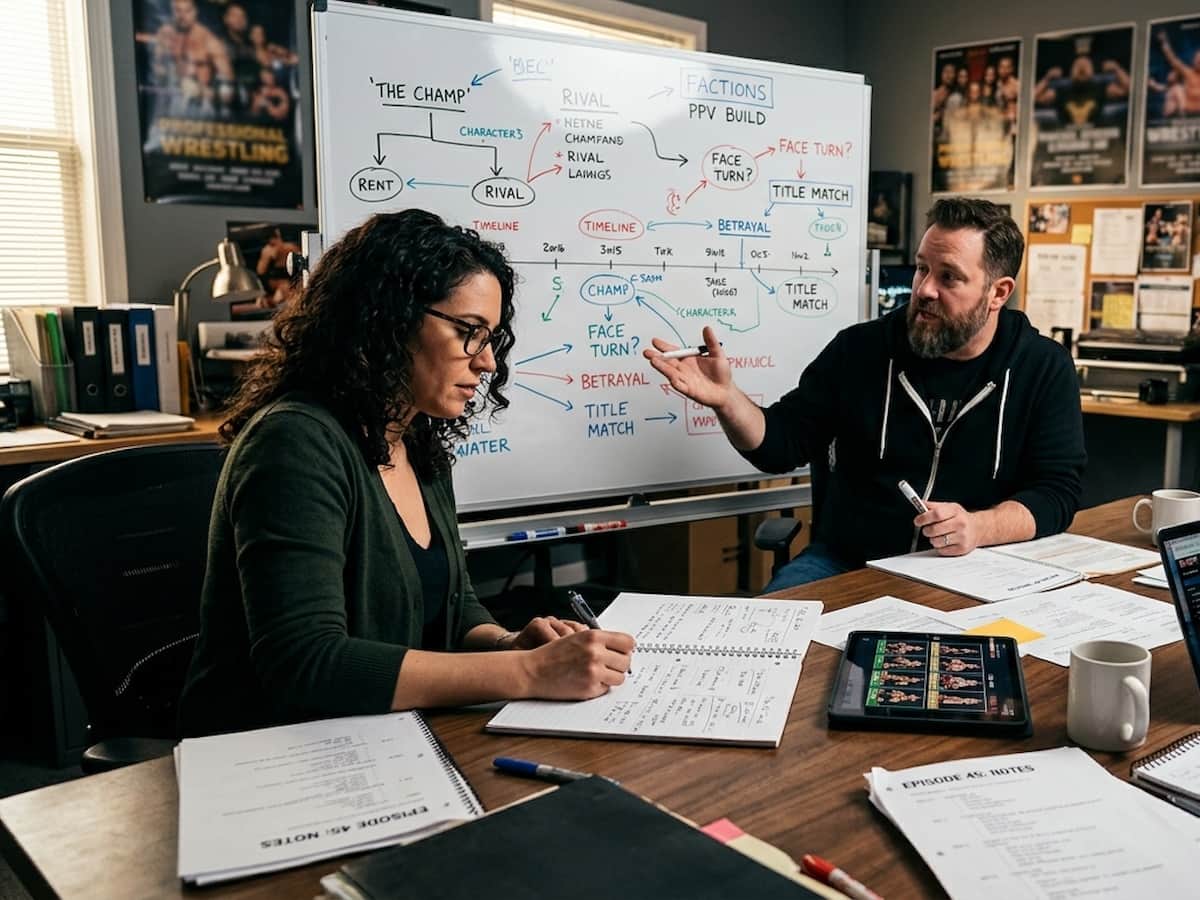
WWE operates two primary weekly television shows — Raw and SmackDown — plus a monthly premium live event calendar that includes major tentpole events like WrestleMania, SummerSlam, and Royal Rumble. Each of these requires ongoing storylines, and the sheer volume of content demanded means that wrestling storytelling, at the WWE level, functions more like a television writers' room than like any traditional creative process.
For most of WWE's modern history, creative authority flowed directly from Vince McMahon, who maintained an almost total grip on storyline direction, character development, and even specific dialogue and promo scripts well into his seventies. Writers — many of them hired from conventional television backgrounds — would develop pitches and scripts, but McMahon's rewrites were legendary, sometimes continuing up to and during live broadcasts. Former WWE creative team members have described receiving completely rewritten scripts minutes before airtime, or watching Vince communicate changes to performers via headset while a segment was already in progress.
Since McMahon departed from the company in 2022 amid a misconduct investigation, creative direction has shifted substantially. Paul “Triple H” Levesque, who took over as Chief Content Officer, has been widely credited by wrestlers and observers with implementing a more collaborative, longer-range creative process — one that relies less on last-minute chaos and more on planned story arcs with defined endpoints.
A typical WWE creative process for a major storyline involves a team of writers developing an arc over weeks or months, pitching it through layers of approval, working with the wrestlers involved to integrate their real-life characters and promo abilities into the material, and then executing it across a television calendar that has to accommodate injuries, contract negotiations, and the unpredictable reality that live audiences may or may not respond the way anyone anticipated.
All Elite Wrestling: A Different Creative Model
When All Elite Wrestling launched in 2019, it introduced a meaningful alternative to WWE's centralized creative model. Founded by Tony Khan — son of Jacksonville Jaguars owner Shahid Khan — AEW positioned itself explicitly as a talent-friendly alternative where wrestlers had more creative input and fewer scripted constraints.
AEW's creative approach is, by most accounts, considerably less hierarchical than WWE's. Khan himself serves as the primary booker — the person responsible for planning match outcomes and storyline direction — and wrestlers at AEW have described significantly more latitude to develop their own characters and promo material. Where WWE tends toward fully scripted promos (word-for-word scripts that performers are expected to deliver with minimal deviation), AEW leans more toward bullet-pointed talking points that performers flesh out in their own voice.
The tradeoff is consistency. AEW has been praised for allowing performers to feel more authentic and for booking decisions that reflect genuine respect for match quality and long-term storytelling. It has also been criticized for storylines that begin without clear endpoints, for a roster so large that many performers go weeks without television time, and for booking decisions that appear to reflect personal relationships and backstage politics as much as creative merit. Wrestling promotions are not immune to organizational dysfunction, and the more informal a creative structure, the more visible those dynamics tend to become in the product on screen.
The Booker: Wrestling's Equivalent of a Showrunner
In wrestling, the person responsible for planning overall story direction — who feuds with whom, who wins championships and when, how long a program between two performers runs, and how major events are structured — is called the booker. The term comes from the regional territory era, when a promoter would “book” matches for a given city or region. In the modern context, it functions roughly like a showrunner in television: the person with final creative authority over the direction of the product.
Great bookers are regarded with enormous respect within the industry. Jim Cornette, a veteran promoter and manager, is considered one of the most analytically rigorous thinkers about traditional wrestling storytelling. Paul Heyman's booking tenure at ECW in the 1990s is credited with revolutionizing the industry by integrating hardcore wrestling, cinematic production values, and emotionally complex character work in ways that influenced both WWE and WCW. Pat Patterson, WWE's long-serving agent and Patterson's own legendary Royal Rumble match concept, helped define modern WWE storytelling structures.
What distinguishes good booking from bad booking, in the view of most wrestling analysts, comes down to a few consistent principles: compelling characters with clear motivations, logical cause and effect (actions having consequences), satisfying payoffs to established storylines, and the basic dramatic structure of building anticipation and then delivering on it. These are not wrestling-specific principles — they're the principles of storytelling in any medium. The specific challenge of wrestling is executing them live, in front of an audience that has significant power to derail plans in real time.
When the Audience Rewrites the Story
This is one of the most distinctive and fascinating aspects of professional wrestling storytelling: the live audience is functionally a co-writer, and their reactions have historically redirected major storylines in real time.
Wrestling bookers track crowd response carefully, because a performer who isn't connecting with an audience — regardless of the intended creative direction — is a performer who isn't working. The most famous example of audience reaction redirecting a major story is Steve Austin's heel turn in 2001: WWE attempted to turn Austin into a villain, but crowds refused to boo him. The storyline collapsed under the weight of audiences who simply wouldn't go along with the planned direction.
The inverse happens too. Performers who weren't slated for major pushes have been elevated to main event status because crowds organically responded to them in ways that exceeded anyone's expectations. Daniel Bryan's rise to the main event of WrestleMania 30 in 2014 is perhaps the most celebrated example — a sustained, months-long audience revolt against WWE's planned direction that eventually forced a story rewrite that became one of the most emotionally resonant WrestleMania moments in the event's history.
This real-time feedback loop is something that has no equivalent in television or film. A television showrunner finds out whether their story decisions worked months after the fact, through ratings and critical response. A wrestling booker finds out within seconds, in the sound of a crowd either erupting or going quiet, and has to make adjustments — sometimes immediately, sometimes over the following weeks — based on what they hear.
Agents, Producers, and the People You Never See
Between the writers' room and the performers in the ring sits a layer of the creative operation that rarely gets discussed publicly: the agents and producers. These are typically former wrestlers who work backstage to translate creative decisions into executable matches and segments.
When a match or segment is planned, an agent is assigned to work with the performers involved. They'll conduct a “producer meeting” — sometimes called a “road agent meeting” — where the planned beats of a match are discussed, including the finish (the planned ending sequence) and any specific spots (planned high-impact moments) that the creative team wants incorporated. The performers then typically go to a private area — in WWE, this is called “laying out” the match — to plan the broad structure of what they'll do.
What actually happens in the ring is a collaborative improvisation built on top of that structure. Elite performers call the match “in the ring” — communicating in real time through subtle hand signals, whispered words, and a shared vocabulary of timing and spacing developed over years of experience. A match might have three or four firmly planned sequences and a specific finish, with everything in between improvised in response to what the crowd is responding to and what feels right in the moment.
This is why the best professional wrestling performers are often described as combining athleticism, acting ability, and improvisational instinct in roughly equal measure. The physical skill is visible. The storytelling and improvisation that shape every moment between the rehearsed spots is the part most casual viewers never register — and the part that most separates good wrestlers from great ones.
The Long Game and the Short Game
Wrestling storytelling operates simultaneously on multiple time horizons, and managing them is one of the central challenges of running a major promotion.
The long game involves major storylines planned months or even years in advance — the setup of a championship reign, the slow build of a rivalry, the construction of a WrestleMania main event. These require planting seeds early, resisting the temptation to cash in storyline equity too quickly, and trusting that audiences will remain engaged across extended periods.
The short game is everything that happens week to week — keeping television engaging, giving performers meaningful things to do between major storyline beats, and responding to the constant variables that live production introduces. Injuries are perhaps the most disruptive: a major star going down with a legitimate injury can collapse months of planned storylines overnight, requiring improvised solutions that ideally look intentional to the viewer.
The best wrestling storytelling makes the short game and the long game feel continuous — where each week's television feels like a meaningful chapter of a larger narrative rather than a disconnected series of events. When that works, it's a genuinely impressive creative achievement. When it doesn't, you get what critics call “week-to-week booking” — television that feels reactive and purposeless, where storylines begin without apparent direction and end without satisfying resolution.
Why It's Harder Than It Looks
The cultural dismissal of pro wrestling as lowbrow entertainment tends to obscure how technically demanding the storytelling actually is. You are asking performers to execute a physically dangerous athletic presentation, tell a coherent story within that presentation, respond in real time to thousands of people expressing immediate opinions about every decision, do all of this live with no retakes, and then recover from whatever actually happened and show up the next week to continue a story that may have just been partially derailed by an injury, a crowd that didn't cooperate, or a last-minute change from creative.
The best performers and bookers in the history of the industry were doing something genuinely difficult and, at their peak, genuinely artful. The fact that it's scripted doesn't make it easier. If anything, the combination of predetermined outcomes with the requirement to make those outcomes feel earned and emotionally resonant in real time, in front of a live crowd, is a creative constraint that most other entertainment forms never have to navigate.
The next time you watch a wrestling crowd lose its mind for a moment that felt inevitable in retrospect — a championship change, a surprise return, a babyface comeback that lands exactly right — know that somewhere in a production office, a writers' room, a parking lot conversation, or an in-ring improvisation, a series of decisions were made, argued over, revised, and executed in order to make that moment feel spontaneous.
That's the work.
Sources:
- Wrestling Observer Newsletter — Dave Meltzer https://www.f4wonline.com
- Have a Nice Day: A Tale of Blood and Sweatsocks — Mick Foley, ReganBooks https://www.harpercollins.com
- The Squared Circle: Life, Death, and Professional Wrestling — David Shoemaker, Gotham Books https://www.penguinrandomhouse.com
- Something to Wrestle With Bruce Prichard — Podcast, historical WWE creative context https://www.podcastone.com
- Kayfabe Explained: A History of Wrestling's Broken Fourth Wall — ESPN https://www.espn.com