
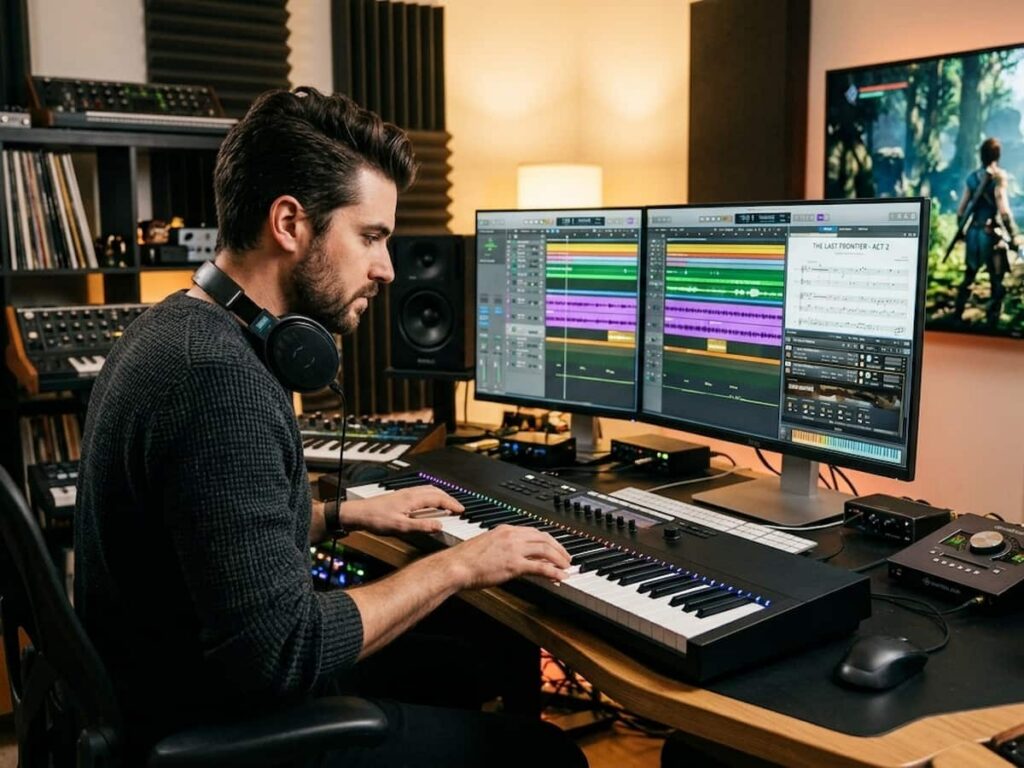
When you think about your favorite video game, chances are the music comes to mind almost immediately. The sweeping orchestral score of The Elder Scrolls V: Skyrim. The tense, looping jazz of Persona 5. The chiptune melodies of Undertale. The ambient dread of Dead Space. Game music has a way of burrowing into your memory in a manner that film scores rarely match, and there's a specific reason for that — one that has everything to do with how the music is built from the ground up.
Making music for a video game is fundamentally different from composing for any other medium. It's not like writing a film score, where the music plays once over a fixed sequence of images. It's not like writing an album, where the listener experiences songs in a controlled order. Game music has to live inside an unpredictable, interactive system — it has to respond to what the player is doing, stretch and compress in real time, and never feel out of place, no matter how long the player lingers in a given area. That's an entirely different creative and technical problem, and solving it involves a combination of artistry, engineering, and a surprising amount of improvisation.
Here's how it actually works.
It Starts Long Before Anyone Writes a Note
Before a composer sits down at a piano or opens a DAW (digital audio workstation), there's a significant amount of conversation that has to happen between the music team and the rest of the development studio. Game music doesn't exist in a vacuum — it exists in relationship to everything else: the art style, the narrative tone, the gameplay mechanics, the pacing, the target audience, and the technical limitations of the platform the game will run on.
In large studio productions, a composer will typically receive what's called a music brief — a document outlining the emotional targets the music needs to hit, the reference tracks the creative director has in mind, the number of distinct musical areas the game will have (a hub world, a combat zone, a boss encounter, a cutscene), and any hard technical constraints like file size limits or audio middleware specifications.
At smaller indie studios, this process is often much more informal. A composer might get a build of the game to play, a short conversation with the lead developer, and a general vibe. Toby Fox composed the entire soundtrack for Undertale largely on his own, working in close feedback loops with himself as both composer and game designer. Lena Raine created the music for Celeste in close collaboration with the development team, carefully matching musical tension to the precise difficulty curve of each chapter.
The point is: the creative conversation comes first, and it shapes everything that follows.
Writing Music That Doesn't Have a Fixed Length
One of the first things that separates game composition from almost every other form of music-making is the problem of time. In a movie, a scene is four minutes and twenty seconds long, full stop. The composer writes four minutes and twenty seconds of music, and that's what plays. In a game, a player might spend three minutes in a forest area, or they might spend forty-five. The music has to work for both.
The most common solution to this is looping — writing a piece of music with a carefully crafted beginning and endpoint that connect seamlessly, so the track can repeat indefinitely without the listener noticing the seam. This sounds simple, but writing a loop that doesn't feel repetitive or grating after multiple cycles is genuinely difficult. Composers have to think about melodic variety within a single loop, about how long the loop needs to be before repetition becomes noticeable, and about where harmonic tension and release are placed so the music feels alive rather than mechanical.
More sophisticated games use a technique called layered or vertical remixing. Rather than a single looping track, the composer writes multiple stems — a percussion layer, a bass layer, a melody layer, an ambient layer — that can be combined in different ways depending on what's happening in the game. When the player enters a combat encounter, the percussion stem might fade in. When combat ends, it fades back out, and only the ambient and melodic layers remain. The music is always changing, but it always sounds cohesive because all the stems were written to work together.
The Halo series made sophisticated use of this technique, and it's become a standard approach in action-adventure and open-world games where the emotional state of play shifts constantly.
Adaptive Music and the Middleware That Makes It Work
The technology that actually executes all of this in real time is a category of software called audio middleware. The two dominant tools in professional game development are FMOD and Wwise, and understanding what they do helps explain how the gap between “music as composed” and “music as experienced” gets bridged.
Both tools allow audio designers and composers to build systems — essentially flowcharts of musical states — that define how music behaves in response to game events. A system might say: when the player enters Zone A, crossfade from Track 1 to Track 2 over four seconds. If the player's health drops below 20%, introduce the tension stem. If the player dies, trigger the failure sting and then return to the ambient loop. If the player enters combat, transition to the combat layer at the next measure boundary so the transition feels musical rather than jarring.
That last detail — transitioning at a musically logical point rather than the instant a trigger fires — is called a musical quantization, and it's one of the most important techniques in adaptive audio. Without it, music transitions would feel abrupt and random. With it, the system waits for the right beat or bar before making the switch, preserving the rhythmic integrity of the music even as it changes in response to gameplay.
This is where game audio becomes a genuinely technical discipline, not just an artistic one. Composers working in games often need at minimum a working knowledge of these tools, and in many studios, the role of audio designer exists specifically to handle the implementation side while the composer focuses on writing.
The Orchestra, the Laptop, and Everything in Between
Game music gets created on an enormous spectrum of production scales, and the process looks radically different depending on where a project falls on that spectrum.
At the high end, major releases from studios like Sony Santa Monica, Naughty Dog, or CD Projekt Red will record live orchestras for their scores. Composers like Bear McCreary (God of War) and Marcin Przybyłowicz (The Witcher 3) work with large ensembles recorded in professional scoring stages — the same environments used for Hollywood film scores. These sessions involve extensive pre-production: mock-ups of every piece created using high-quality virtual instruments, reviewed and approved by creative directors, before a single live musician is booked.
Live orchestral recording at this level involves music contractors (who handle hiring the musicians), orchestrators (who translate the composer's piano or MIDI sketches into full orchestral parts), copyists (who produce the individual printed parts each musician plays from), conductors, recording engineers, and mixing and mastering engineers. The composer is one node in a large production system.
At the indie level, the entire process might live inside a single person's bedroom studio. Modern sample libraries — software instruments that use high-quality recordings of real instruments — have become sophisticated enough that a skilled composer working alone can produce music that sounds remarkably close to a live ensemble. Tools like Spitfire Audio's BBCSO (BBC Symphony Orchestra) library or EastWest's Hollywood series give independent composers access to sounds that would have required a major studio budget twenty years ago.
And then there's chiptune and lo-fi retro composition, where artists deliberately embrace the sonic limitations of old hardware — the NES's five audio channels, the Game Boy's four-channel sound chip — either by using actual vintage hardware or by using modern software that faithfully emulates those constraints. This is both an aesthetic choice and, for some composers, a technical love letter to the medium's history.
The Role of Silence (and Sound Design)
A piece of game audio advice that gets passed around in the industry: silence is a mix element. It's not the absence of music — it's a creative decision that carries as much weight as any note.
Many of the most effective moments in game audio are the moments when the music stops entirely. The sudden quiet when you enter a room in a horror game. The absence of a combat track after a particularly brutal fight. The stillness before a boss encounter begins. These silences work because the music around them has established a baseline expectation — and violating that expectation, even by taking music away, creates a response in the listener.
Closely related is the overlap between music and sound design, a boundary that has become increasingly blurry in modern game development. Composers like Akira Yamaoka (Silent Hill) and Jesper Kyd (Hitman, Assassin's Creed) built soundscapes where musical elements and sound design elements are essentially indistinguishable — industrial noise becomes rhythm, ambient texture becomes melody. The audio is doing emotional and narrative work that sits somewhere between music and environment.
Why Game Music Sticks With You
There's a psychological dimension to why game music tends to be so persistently memorable, and it comes down to repetition combined with emotional investment.
When you're playing a game and something exciting or frightening or beautiful happens, your brain is engaged at a high level — you're making decisions, experiencing consequences, feeling genuine stakes. The music that accompanies those moments gets encoded in memory alongside the experience itself. Unlike a film, where you watch the same scene once, a game might put you in a particular musical environment for hours across multiple sessions. The music becomes inseparable from how you felt during those hours.
This is why people who played The Legend of Zelda: Ocarina of Time as children can still hum the Lost Woods theme twenty-five years later. The music isn't just background — it's embedded in a memory of play, of discovery, of the specific feeling of being inside that game world at that moment in their lives.
The Craft Behind the Curtain
Game music composition is a discipline that demands unusual fluency — in music theory, in technology, in storytelling, and in the psychology of interactive experience. The best game composers understand that their job isn't to write music that sounds impressive in isolation, but to write music that serves a living, unpredictable system and makes the person playing feel exactly what the game needs them to feel, at exactly the right moment.
The next time a piece of game music gives you chills, know that somewhere behind it is a composer who spent a significant amount of time figuring out precisely how to make that happen — and a team of engineers who figured out how to make it happen at the right beat, in the right key, at exactly the right moment the game decided you were ready.
Sources:
- The Guide to MIDI Orchestration — Paul Gilreath, Focal Press https://www.routledge.com
- A Composer's Guide to Game Music — Winifred Phillips, MIT Press https://mitpress.mit.edu
- FMOD Audio Middleware Documentation — FMOD https://www.fmod.com/docs
- Wwise Interactive Audio Engine — Audiokinetic https://www.audiokinetic.com
- Writing Music for Video Games — Berklee Online https://online.berklee.edu